

How to Clean a Bike Carburetor, Signs It Needs Cleaning vs Replacing - GoSpares
If your bike has been sitting in the garage longer than usual, or if your daily commuter has suddenly started acting up, rough idling, poor mileage, hard starts, the carburetor is almost always the first place to look.
Most riders in India either ignore the problem until the bike stops working completely, or rush straight to a mechanic who recommends a full replacement without explaining why. The truth is, a carburetor that "needs replacing" can often be sorted with a proper cleaning, if you catch it at the right time.
This guide will help you understand exactly what's happening inside your carburetor, how to tell if it just needs a clean, and when it's genuinely time to replace it.
What Does a Carburetor Actually Do?
Before anything else — it helps to understand what the carburetor's job is.
Your bike's engine needs a precise mixture of petrol and air to run. Too much fuel and it runs rich — black smoke, poor mileage, engine flooding. Too little fuel and it runs lean — overheating, loss of power, hard starts.
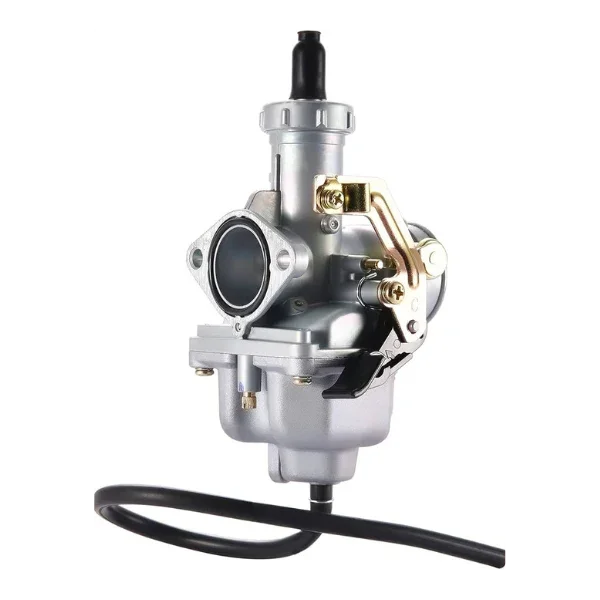
The carburetor is the component that manages this mixing. It has tiny jets, passages, and a float bowl that work together to deliver the right ratio of fuel and air depending on your throttle position, engine speed, and load.
The problem? These jets and passages are extremely small. Dust, old fuel residue, and moisture can clog them over time — especially on Indian roads where dust and stop-start city traffic are part of daily riding life.
Signs Your Carburetor Needs Cleaning
These are the early warning signs, the ones riders usually ignore or dismiss
1. Difficult cold starts If your bike cranks fine but takes multiple kicks or attempts to fire up — especially on winter mornings — a partially clogged carburetor jet is usually the reason. The pilot jet, which handles low-speed fuel delivery, is often the first to clog.
2. Rough or unstable idling When your bike is warming up at a traffic signal and the RPM keeps hunting — going up and down without you touching the throttle — that's a classic sign of a dirty carburetor. The engine is struggling to maintain a stable fuel-air ratio.
3. Engine stalling at low speeds Particularly frustrating in city traffic. The bike feels normal at higher speeds but cuts out when you slow down or come to a stop. This points to a clogged idle circuit inside the carburetor.
4. Sudden drop in fuel efficiency If your Hero Splendor that used to give 65 kmpl is now struggling to cross 50, and nothing else has changed — check the carburetor first. A partially blocked main jet causes the engine to run rich, burning more fuel than needed.
5. Black smoke from the exhaust Black smoke means unburnt fuel is passing through the engine. Rich mixture. Most commonly caused by a stuck float needle that lets too much fuel into the float bowl — often fixable with a cleaning.
6. Sluggish throttle response You twist the throttle and there's a pause before the engine responds. Like the bike is thinking about it. Partially clogged needle jet — a cleaning usually sorts this.
7. Bike runs fine when warm but struggles when cold The choke circuit handles cold starts. If your bike won't start without the choke but runs fine once warm, the choke passage inside the carburetor is likely blocked.
If you're seeing two or three of these signs together — your carburetor almost certainly needs a cleaning before anything else.
How to Clean a Bike Carburetor at Home
You don't need to be a mechanic to clean a carburetor. You need patience, a basic toolkit, and a can of carburetor cleaner spray, available at Gospares and get it delivered to your doorstep.
What you'll need:
- Carburetor cleaner spray
- Flat-head and Phillips screwdrivers
- A small adjustable spanner or ring spanner set
- A clean cloth or rag
- A small container to keep screws and jets
- Compressed air (optional but helpful)
Step 1 — Turn off the fuel tap
Located on the petrol tank, usually marked ON/OFF/RES. Turn it to OFF before starting.
Step 2 — Remove the air filter box
The carburetor sits between the air filter and the engine intake. Remove the air filter cover and filter element first, then disconnect the air filter box from the carburetor inlet.
Step 3 — Disconnect the fuel line
Place a cloth under the carburetor before disconnecting the fuel line — there will be some petrol spillage. Use a clamp or simply pinch the line before disconnecting.
Step 4 — Disconnect the throttle cable
On most Indian bikes, the throttle cable connects to the top of the carburetor. Loosen the cable adjuster and slip the cable end out of its seat. Do not force it.
Step 5 — Remove the carburetor
Loosen the clamps holding the carburetor to the intake manifold, rotate gently, and pull it free.
Step 6 — Drain the float bowl
Locate the float bowl screw at the bottom of the carburetor. Loosen it and let the old fuel drain out. Old fuel that has been sitting can look brownish or have a varnish-like residue — this is often the main cause of clogging.
Step 7 — Remove the main jet and pilot jet
Using a flat-head screwdriver, carefully unscrew the main jet (the larger one in the centre of the float bowl area) and the pilot jet (the smaller one). These are the most commonly clogged parts.
Step 8 — Clean the jets
Spray carburetor cleaner through each jet and hold it up to light — you should see clean light coming through the hole. If not, use compressed air or a very fine wire (thin strand from a wire brush) to clear the blockage. Never use a drill bit or anything that could enlarge the jet opening — even a fraction of a millimetre difference affects performance.
Step 9 — Clean the carburetor body
Spray carburetor cleaner through all the passages, ports, and the main venturi. Pay special attention to the idle circuit passages — small holes around the throttle butterfly area. Use compressed air to blow everything clear.
Step 10 — Reassemble and reinstall
Screw the jets back in gently — overtightening strips the soft aluminium threads. Reassemble in reverse order, reconnect the throttle cable, fuel line, and air filter box.
Step 11 — Start the bike and check idle
Turn the fuel tap back ON. Start the bike and let it warm up for 2–3 minutes. Check idle stability and throttle response. If the idle seems off, adjust the idle screw (usually a large knurled screw on the side of the carburetor) until the engine idles smoothly.
How long does it take? First time — 1.5 to 2 hours. Once you've done it once, under 45 minutes. How much does it cost? DIY cleaning costs ₹200–₹400 (cleaner spray only). At a mechanic, expect ₹500–₹1,500 depending on your bike and the mechanic's rates.
Signs Your Carburetor Needs Replacing , Not Just Cleaning
Cleaning fixes clogging problems. But some carburetor issues go beyond clogging — and no amount of cleaning will fix them.
1. Physical damage to the carburetor body Cracks in the casting, broken mounting flanges, or a cracked float bowl mean the carburetor cannot hold proper vacuum or seal correctly. Cleaning does nothing here, replacement is the only fix.
2. Worn throttle shaft The throttle shaft runs through the centre of the carburetor and opens the butterfly valve when you twist the throttle. Over time, the shaft bore wears, causing air leaks. Symptoms include an engine that revs on its own or won't idle below 2,000 RPM regardless of idle screw adjustment. This cannot be cleaned away.
3. Fuel leaking from the carburetor body If petrol is dripping from the carburetor body itself (not the float bowl drain) there are cracks or porosity in the casting. Replace.
4. Float is damaged or saturated The float controls fuel level in the float bowl. If the float develops a hole and fills with petrol, it sinks and lets fuel overflow constantly flooding the engine. You can sometimes replace just the float, but if the seat is also damaged, replacing the full carburetor is the more reliable fix.
5. Stripped jets If the main jet or pilot jet threads are stripped from overtightening or previous poor repairs the jets cannot seal properly, causing an uncontrollable rich mixture. A new carburetor is the solution.
6. Repeated cleaning with no improvement If you've cleaned the carburetor properly two or three times and the same symptoms keep coming back within weeks the internal wear is beyond what cleaning can address. Time to replace.
The simple rule: clean first, replace only when cleaning doesn't fix it or when there is physical damage.
Carburetor Cleaning vs Replacing — Quick Decision Guide
| Symptom | Clean First | Replace |
|---|---|---|
| Hard starting | ✅ Yes | Only if cleaning fails |
| Rough idling | ✅ Yes | Only if cleaning fails |
| Poor mileage | ✅ Yes | Only if cleaning fails |
| Black smoke | ✅ Yes | Only if float is damaged |
| Fuel leak from body | ❌ No | ✅ Yes |
| Throttle won't return | Check cable first | If shaft is worn |
| Engine revs on its own | ✅ Try cleaning | If shaft bore is worn |
| Repeated problems after cleaning | ❌ No | ✅ Yes |
| Physical cracks visible | ❌ No | ✅ Yes |
How Often Should You Clean Your Bike Carburetor?
For most Indian commuter bikes ridden daily in city conditions, every 6 months or 5,000 km, whichever comes first. If your bike sits unused for more than 3–4 weeks, drain the float bowl before storage and do a quick clean before running it again — old petrol gums up jets faster than anything else.
Which Carburetor Should You Buy If You Need a Replacement?
If cleaning doesn't solve the problem and your carburetor is beyond repair, choosing the right replacement is important for performance, fuel efficiency, and long-term reliability.
At GoSpares, you can buy both Genuine OEM carburetors as well as high-quality aftermarket OES carburetors for a wide range of Indian motorcycles and scooters. Whether you own a Honda Activa, Hero Splendor, Bajaj Pulsar, TVS Apache, Suzuki, or an older discontinued model, we offer reliable replacement options to match your bike's specifications.
All carburetors available on GoSpares are sourced from trusted manufacturers and are designed to provide proper fitment and dependable performance.
Looking for the right carburetor? Simply search for your bike model on GoSpares or contact us at +91-9289311783. Our team can help you find the correct Genuine OEM or OES replacement carburetor for your vehicle.